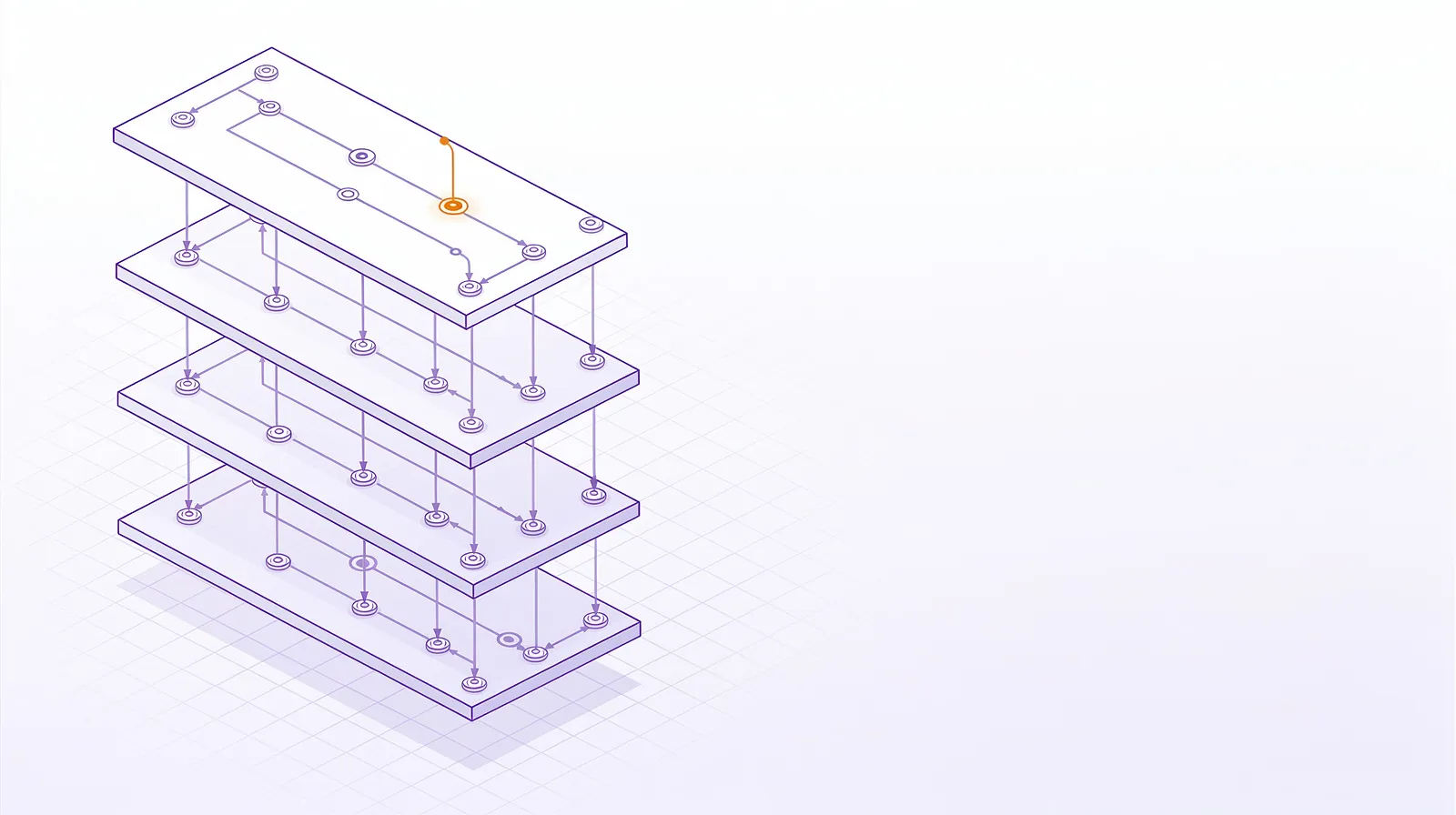
It is easy to draw this as a marketing stack. Enrichment, routing, attribution, search, and an agent named on each layer. A team with no agents could run that chain. A journey tool already does. It fires the next step when a field changes. It does not choose a procedure. It does not share a memory. It does not get better because someone corrected the last run.
The agent was a label. The system was missing.
What is actually an agent system
Three files, and a loop that uses them. The files are not tools in a catalog. Each one has a different job, and mixing them up is how the stack comes back.
- Context fileA person writes it. Every run loads it. It holds what does not change with the task.
- SkillThe procedure for a class of work. The loop sees the name. It loads the file only when the job matches.
- The brainWhat is allowed to survive the run. The next run is different only because this one was written down.
A context file is standing orders. The capability the play is about. The definition of a source. The messaging tier. The list of things an agent must never write. Who holds the gate. If it is not in the file, the run does not have it. A wiki nobody loads is not a context file. A slide deck is not one either.
A skill is how a class of work is done. Rank this signal. Draft inside this tier. Stamp a source from the record of that moment. Write a fact back with a citation, or refuse to write it. The loop can see every skill by name. It pulls the full procedure only for the job in front of it. A prompt you paste once is not a skill. The next account will not find it.
The brain is the memory. Cited facts. A play that was retired. A correction a person made. The outcome of the last run. The model does not remember any of that. The brain does. Enrichment, routing, and search can be skills. They are not the system. If the only records in the brain are products, the loop will keep proposing the next product.
Start from the capability. A capability is what the customer needs and does not have yet. The product is what you sell once that is clear. The context file says which capability a play is for. Orchestration matches a signal to that record. It does not match to the catalog.
How the agents touch the brain
The five lanes still do the work. Intake ranks. Decomposition drafts. The steward maintains the record. Rollup reads the outcome. Governance stops the others and does not ship. Orchestration is not a sixth marketer. It is the loop that decides which lane runs, which skill that lane loads, and what it is allowed to read.
They do not pass a spreadsheet to each other. They read the same brain. Only the steward writes back, and only a fact it can cite. Governance can stop the write. The dashed path is the next run. It starts from what was written, not from a blank prompt.
- Context file: rules a person wrote, loaded every run.
- Skill: the procedure, loaded only when the job matches.
- Orchestration: picks the skill, the agent, and the order, then assembles what the run needs from the brain.
- The brain: cited facts, retired plays, and the last correction. Every agent reads it.
- Intake ranks the signal. Decomposition drafts the work. The steward writes a cited fact back. Rollup reads the outcome. Governance can stop the write.
- The next run reads what the steward was allowed to write.
What the loop does
A campaign journey sequences messages. Orchestration sequences work against the brain. Five moves, and the last one is the point.
- 1Match
- 2Select
- 3Assemble
- 4Assign
- 5Write back
Match the signal to a capability already in the brain. The signal has to say where it lives, how it was detected, which capability play it triggers, and who owns the next step. If a field is blank, the loop does not start. A product name is not a match. A confirmed need can become work. A verified change gets a short look. A single inferred visit does not open a task. A high-fit account with no signal still goes to a person. The loop does not invent a play to fill a queue.
Select one skill. Do not load every procedure into the run. The context window is not the memory. If two skills could apply, a person picks. The loop does not blend them and hope.
Assemble only the context that skill needs. The capability. The tier. The cited facts. The last correction on this kind of work. A retired play comes back as a refusal, not as a draft. Standing rules come from the context file. Facts come from the brain. The procedure comes from the skill. Three different places, on purpose.
Assign one agent. Intake ranks. Decomposition drafts inside the tier the context file names. The handoff is a write to the brain, not a side channel between agents. If an agent keeps a private copy, the next run will not see it, and the private copy will be wrong.
Write back, or write nothing. The steward may record a fact it can cite, with the kind of source and a date. Customer-stated, sales-reported, approved, analytics-derived, inferred, outdated, unverified. Those are not the same fact. Governance blocks a write the context file forbids. Claims, pricing, positioning, and roadmap facts stay with a person, with no end date. So does creating the work before someone says yes. A person accepts any change to a skill or to the context file. An agent may propose the edit. It does not merge it.
The context file says what a source is. Last touch, written at creation, from the record of that moment. The agent may stamp that. It may not invent one, leave one blank, or rewrite it later. Influenced is a view rollup may show. It is not sourced. The 2026 record is 100% of sourced opportunities attributed to a channel. That is the marketing-sourced population. It is not a score for the agents, and it is not evidence the brain got smarter.
Where the next run gets better
I am not tying a rate to this. There is no baseline yet for whether a corrected mistake stays corrected.
The mechanism is the write. A person corrects a draft. That correction is stored as a cited fact, or the play is marked retired. The next orchestration reads it before it selects a skill. The skill file did not get smarter. The brain did. If the correction never lands, the agent makes the same mistake on the next account. That is a writeback failure, not a model failure.
- DriftA fact stays after it is stale. The next run treats it as current.
- BlurOne account's correction becomes a rule for every account.
- PollutionAn agent writes what it cannot cite. The next run treats it as settled.
Governance is the lane that stops those writes. A watcher may flag a stale fact. It does not fix, block, or decide until it has a record of being right. Routine writeback is earned the same way. On demand first. A standing write only after a person will sign for the pattern.
What I would not call this
The failure this is written to prevent: a catalog of tools, each with its own agent, none of them reading the same brain. The work looks automated. The next run is as ignorant as the last one.
The second failure is a brain everyone can write to. Speed without a citation, and the memory rots. The third is waiting on instrumentation or shopping for a platform that claims to be the loop. Until the context file, the skill, and the writeback exist, run the handoff by hand.
Evaluation, when it exists, watches one thing this guide cares about. Whether a corrected mistake came back. Alongside it, the same watches as the agent lanes: whether the answer was right, whether the citation was the right kind, how often a fact was stale, and whether a person’s time moved back to the decision. None of those have a baseline yet. I will not borrow another guide’s ratio to fill the gap.